
- The Chasm Between B2B Search Queries and On-Site Experience
- Continuous Iteration: The Feedback Loop from Analytics to UX Enhancements
- Why B2B Search Intent Doesn't Match B2C Patterns
- The Three Information Gaps That Kill B2B Conversion
- Mapping Search Intent to Page Templates
- Research-Stage Pages
- Specification-Stage Pages
- Reorder-Stage Pages
- Where Shopify Plus B2B Tooling Helps (and Where It Doesn't)
- The Measurement Loop That Tightens It Over Time
- Related Reading
The Chasm Between B2B Search Queries and On-Site Experience
B2B digital commerce is not merely an extension of B2C. Enterprise merchants operating on personalization for B2B e-commerce are indispensable. What works for one B2B segment might not resonate with another. This requires systematic personalization for B2B e-commerce and informs sales teams.
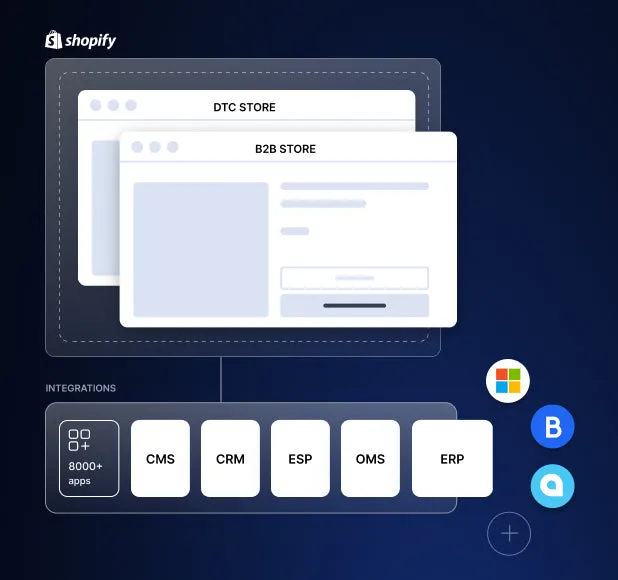
These integrations minimize data silos, improve operational efficiency, and provide a cohesive experience for B2B customers. They are foundational for scaling a sophisticated CRO strategies require understanding the contribution of each interaction.
- Multi-Touch Attribution Models: Employ models like linear, time decay, or position-based attribution. These distribute credit across all touchpoints (e.g., organic search, email, direct, paid ads, content downloads).
- Offline Touchpoint Integration: Incorporate data from sales calls, trade shows, and in-person meetings into your attribution model. CRM integration is crucial here.
- Content-Specific Attribution: Track which content assets (whitepapers, case studies, solution pages) influence conversions at different stages of the journey.
Accurate attribution informs future marketing and UX investments, ensuring resources are allocated to the channels and experiences that genuinely drive B2B growth on Shopify Plus B2B.
Continuous Iteration: The Feedback Loop from Analytics to UX Enhancements
Intent-driven UX is not a one-time project; it's an ongoing process of continuous iteration and improvement. The feedback loop from analytics to UX research and enhancement is vital for sustained success.
This agile approach, informed by data-driven UX design, ensures that your Shopify Plus B2B platform remains optimized and responsive to evolving B2B buyer needs.
- Regular Data Audits: Periodically review all KPIs, identifying trends, anomalies, and areas for improvement.
- User Testing & Surveys: Supplement quantitative data with qualitative insights. Conduct user interviews, usability tests, and gather direct feedback.
- A/B Test Analysis: Thoroughly analyze the results of all A/B tests. Implement successful variations and learn from those that didn't perform as expected.
- Competitive Benchmarking: Continuously monitor competitor sites for new features, content strategies, and UX patterns that resonate with the B2B audience.
By establishing this robust feedback loop, enterprise merchants can maintain a competitive edge, consistently refining their Shopify Plus B2B experience to maximize conversions and foster long-term customer relationships.
Why B2B Search Intent Doesn't Match B2C Patterns
B2C ecommerce search optimization assumes a single decision-maker with relatively short consideration cycles. B2B Shopify Plus traffic violates both assumptions. A B2B buyer querying "wholesale industrial fasteners bulk pricing" is often researching for a procurement committee, working on a 30–90 day evaluation cycle, and needs answers to questions a B2C catalog does not surface: minimum order quantities, lead times, payment terms, certification compliance, and account-specific pricing tier eligibility.
If your Shopify Plus B2B site treats this buyer like a B2C visitor — leading with a product image, retail price, and "add to cart" — you are inviting bounces from your highest-intent traffic. The on-site experience must compress the answers a B2B buyer needs into the first scroll.
The Three Information Gaps That Kill B2B Conversion
- Pricing visibility. Hiding all pricing behind a quote form converts at low single digits. Showing list price with "log in for your tier" converts dramatically better and qualifies the lead in the same motion.
- Availability transparency. B2B buyers do not assume "in stock" — they assume "TBD until I email." Surface real-time inventory, lead times, and bulk-quantity production schedules on the PDP.
- Compliance documentation. SDS sheets, ISO certifications, REACH compliance, country-of-origin docs. Linking them directly from the PDP removes a multi-day procurement evaluation step.
Mapping Search Intent to Page Templates
The fastest B2B UX win on Shopify Plus is segmenting page templates by buyer-stage intent rather than by product type. Three template archetypes cover most B2B search traffic:
Research-Stage Pages
Buyers querying "best industrial X for Y application" land on these. The page should lead with comparison frameworks, application use cases, and decision criteria — not product specs. Conversion is "request technical consultation" or "download spec sheet," not "add to cart."
Specification-Stage Pages
Buyers querying specific part numbers, dimensions, or technical attributes. Lead with full spec tables, downloadable CAD/3D models, and side-by-side variant comparisons. Conversion path is "add to quote" or "add to standing order template."
Reorder-Stage Pages
Buyers who already know what they want. These users hit the site logged in. Optimize for speed: one-click reorder of last order, saved shopping lists, scheduled recurring shipments. Conversion is friction reduction, not persuasion.
Where Shopify Plus B2B Tooling Helps (and Where It Doesn't)
The native B2B features in Shopify Plus give you company accounts, catalog assignment, payment terms, and quantity-break pricing out of the box. These cover the transaction layer well. The gap is the discovery layer: there is no built-in intent-routing engine that serves different content based on inferred buyer stage.
Building this routing yourself is a one-time investment of 2–4 sprints: capture entry queries via UTM and on-site search, classify them into intent buckets with a rules engine or a small classifier model, and serve the appropriate template variant via Shopify Functions or Theme App Extensions. The lift in qualified-lead conversion typically pays back the build within a single quarter for any B2B store doing $5M+/year.
The Measurement Loop That Tightens It Over Time
Instrument three metrics weekly: intent classification accuracy (sample 50 sessions manually, score the algorithm), template-fit conversion (conversion rate per intent bucket per template), and B2B-specific NPS (post-purchase: "how easily did you find what you needed?"). Iterate the routing rules monthly. The intent model gets sharper with usage — the longer it runs, the better the B2B conversion rate becomes.
Frequently Asked Questions
What is intent-driven UX for Shopify Plus B2B?
Intent-driven UX for Shopify Plus B2B is a strategic approach that meticulously designs the user experience to directly address the complex, multi-layered search intent of business buyers. Unlike B2C, B2B purchasing involves longer cycles, multiple stakeholders, and highly specific needs. This UX methodology leverages advanced analytics, AI-powered NLP, and persona-driven research to deconstruct queries beyond keywords, understanding the underlying problem, solution exploration, or transactional requirements. On Shopify Plus, this translates into tailored features like robust faceted search for complex catalogs, custom product configurators, dedicated resource hubs with technical documentation, and streamlined purchase paths accommodating purchase orders, tiered pricing, and multi-user account management. The goal is to reduce friction, guide buyers seamlessly through their journey, and ultimately boost conversion rates and long-term customer value on the Shopify Plus B2B platform.
Why do B2C UX strategies fail for B2B on Shopify Plus?
Generic B2C UX, optimized for individual impulse buys, fails B2B because it cannot accommodate complex B2B needs like multi-user accounts, custom pricing, bulk orders, purchase orders, or intricate approval workflows. B2B buyers require robust self-service portals, detailed specifications, and transparent logistics, which standard B2C experiences lack.
How does structured data improve B2B SEO on Shopify Plus?
Structured data (Schema.org) helps search engines understand the specific intent behind B2B products and services. By marking up product details, offers, organization info, and services, Shopify Plus B2B sites can achieve enhanced visibility in rich snippets, local packs, and knowledge panels, driving highly qualified organic traffic by directly communicating relevance to specific B2B queries.
What KPIs are crucial for measuring intent-driven UX success on Shopify Plus B2B?
Beyond traditional conversion rates, crucial KPIs for intent-driven UX on Shopify Plus B2B include engagement metrics (resource downloads, internal search usage), lead quality and velocity, account activation rate, repeat purchase rate, and customer retention rate. These metrics provide a holistic view of long-term success and customer lifetime value.

Ecommerce manager, Shopify & Shopify Plus consultant with 10+ years of experience helping enterprise brands scale their ecommerce operations. Certified Shopify Partner with 130+ successful store migrations.


![Shopify Plus SEO: Deconstruct Technical Debt [20x Organic Growth]](img/blog/shopify-plus-technical-seo-debt-1.webp)